

Autter platform
Review pull requests, apply team rules, run pre-merge checks, and inspect engineering analytics.
Autter CLI
Record line-level AI authorship in Git and inspect the agent, model, and prompt behind a change.
Autter Runtime
Add lightweight, open source error and usage tracking to your app’s frontend and backend.
Start with the Autter platform
Create an Autter organization, then try a demo repository on GitHub or connect your own GitHub repository or GitLab project. Autter reviews changes in your pull request or merge request workflow.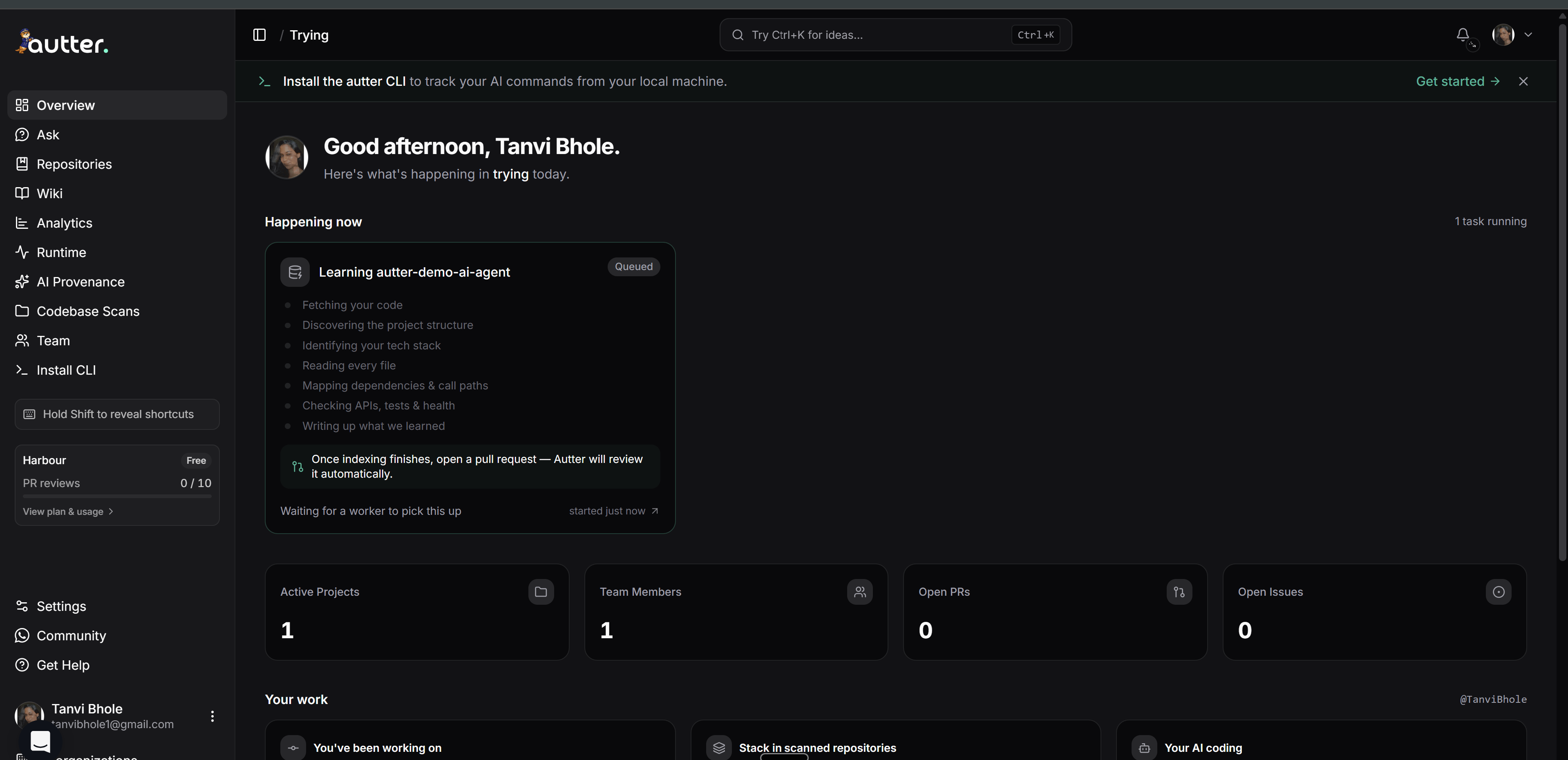
A connected repository in the Autter platform overview.
1
Create your account and organization
Sign up for the Autter platform with GitHub or Google, then create a trial organization.
2
Choose a repository
Use the demo setup to copy a project into your GitHub account, or connect your own repository. Grant Autter access, then add the repository to your Autter organization.
3
Open a pull request
Autter analyzes the diff, repository context, and configured rules before posting feedback.
4
Tune the review
Add team rules and adjust review behavior after you see the first results.
Get your first review
Follow the platform quickstart with a demo repository or your own code.
Start with the Autter CLI
Use the CLI when you need explicit AI authorship and line-level attribution in Git history. It works in local-only mode without an account. Connected mode can send attribution and prompt history to your Autter organization.Install the CLI
Install
autter, choose an operating mode, and verify attribution.Review data and privacy
See what remains local, what enters Git, and what uploads in connected mode.
Explore the platform
Code review
Understand codebase-aware findings, summaries, rules, and merge checks.
Pipeline automation
Add custom checks, test generation, docstring generation, linters, and scanners.
Analytics
Track cycle time, review activity, and engineering trends.
Integrations
Connect Autter to source control, issue trackers, notifications, and editors.
MCP server
Connect a coding agent to read reviews, fix findings, and query the codebase.
Start with Autter Runtime
Autter Runtime is an open source, dependency-light way to track runtime errors and usage in your own app — a <5 KB browser tracker, a curated Node OpenTelemetry setup, and a self-hostable ingester.Runtime quickstart
Go from zero to seeing error and usage data flowing.
Runtime introduction
Understand the packages, supported stacks, and data model.