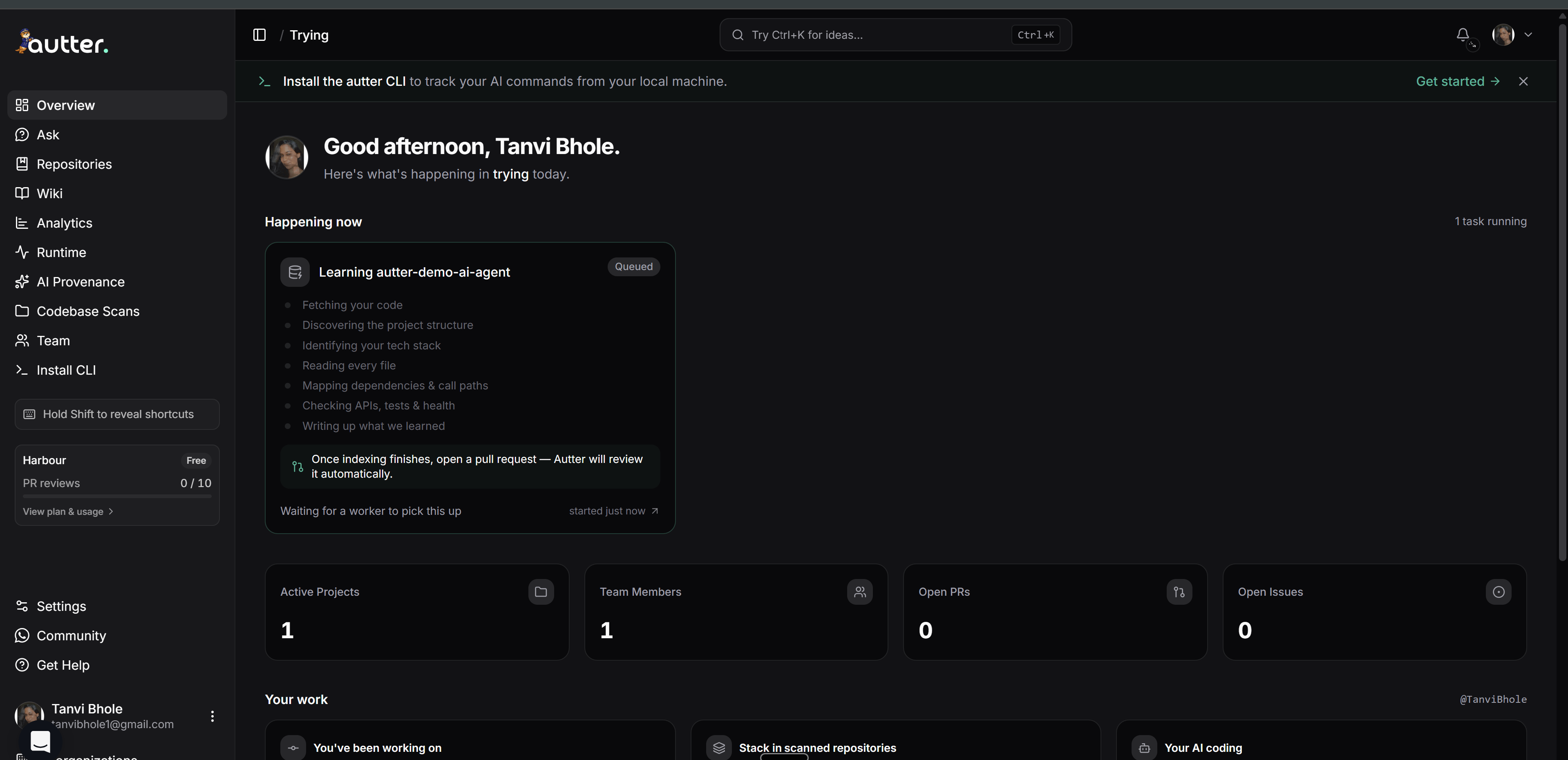
Repository review and scan activity in the Autter platform overview.
What you can accomplish
Review pull requests
Find bugs, edge cases, security risks, and codebase-specific issues before merge.
Automate pre-merge checks
Run custom guardrails, test generation, docstring generation, linters, and scanners.
Apply team standards
Define rules in natural language and use them consistently across repositories.
Measure review workflows
Track cycle time, review activity, repository trends, and team velocity.
Add engineering context
Connect source control, issue trackers, notifications, and editor workflows.
Connect a coding agent
Let an agent read reviews, fix findings, and query the codebase over MCP.
Track AI authorship
Connect explicit line-level attribution from the open source Autter CLI.
Review flow
1
A pull request opens
Autter receives the proposed diff through the connected source control provider.
2
Autter builds context
The review considers repository architecture, established patterns, team rules, documentation, and linked work items when available.
3
Checks run
Autter combines AI review with the enabled linters, scanners, and pipeline checks.
4
Feedback appears
Authors and reviewers receive a summary, inline findings, and suggested fixes in the pull request workflow.
5
The team decides what merges
Use Autter findings with branch policies and human review to make the final merge decision.
Sources of context
Platform and CLI
The Autter platform and Autter CLI solve different parts of the workflow. The platform reviews a proposed change. The CLI records who or what authored each line. When you connect the CLI, your organization can relate review activity to coding agent, model, prompt, and AI authorship context. Review Data and privacy before enabling connected mode.Get started
Try a demo repository or connect your own, then verify your first pull request review.