


Jul 16, 2026
Autter vs CodeRabbit: a reviewer is not a merge gate
Compare Autter and CodeRabbit on AI code review, runtime verification, merge gates, rate limits, and pricing for teams shipping AI-generated code.
Code review used to have a natural speed limit. Engineers could only write so much code, which meant another engineer could usually read the important parts before they reached production.
Coding agents removed that limit on production, but not on attention. Claude Code, Codex, Cursor, Copilot, and internal agents can open more pull requests than an experienced team can responsibly inspect. The bottleneck has moved from producing code to deciding which of it can be trusted.
CodeRabbit and Autter both sit inside that problem. They overlap in several places, and CodeRabbit deserves more credit than the usual “comment bot” comparison gives it. The real difference is not that one tool reviews code while the other does something completely unrelated.
The difference is where each product stops. CodeRabbit is built to produce a better review, while Autter is built to produce a defensible merge decision.
Autter vs CodeRabbit at a glance
Same pull request. Different stopping point.
01 Primary job
CodeRabbit Help developers review and improve pull requests
Autter Decide whether a pull request has enough evidence to merge
02 Main output
CodeRabbit Walkthroughs, comments, fixes, conversations, and check results
Autter Findings, affected systems, runtime evidence, policy results, and a merge verdict
03 Codebase context
CodeRabbit Repository context, code graph, linked repositories, issue context, and team learnings
Autter Application map covering code, APIs, schema, routes, tests, dependencies, owners, and affected journeys
04 Runtime verification
CodeRabbit Linters, scanners, sandboxed custom checks, and generated tests on supported plans
Autter Isolated execution of every pull request, dependency verification, targeted tests, and observed behaviour
05 Merge enforcement
CodeRabbit Available through configured pre-merge checks and Request Changes
Autter The primary product workflow
06 AI governance
CodeRabbit Reviews code produced by coding agents
Autter Records line-level AI authorship, including the agent, model, and prompt
07 Pricing model
CodeRabbit Per developer
Autter Per monthly pull-request volume
08 Usage model
CodeRabbit Rolling hourly limits, with adaptive fair-usage changes
Autter Flat monthly price for a fixed number of pull requests
09 Best fit
CodeRabbit Teams that want faster, broader AI review
Autter Teams that need an assurance layer between coding agents and production
CodeRabbit is good at the job it was built for
CodeRabbit is a mature AI reviewer. It works in pull requests, the IDE, and the CLI, and it combines AI analysis with repository context, code graph analysis, issue context, suggested fixes, and more than 40 linters and security scanners.
It also has real enforcement features. Teams can define built-in or natural-language pre-merge checks, mark them as warnings or errors, and use the Request Changes workflow to block a pull request when an error-mode check fails. Reviewers can resolve the issue or explicitly override the failure, with restrictions available for who is allowed to do that.
That is useful, and pretending otherwise would weaken the comparison. CodeRabbit is no longer limited to leaving suggestions that everyone is free to ignore.
Its centre of gravity is still the review. The product helps a developer or reviewer understand the change, respond to findings, apply fixes, and move the pull request forward. Enforcement sits around that review workflow.
Autter starts at the other end. It assumes that the merge is the decision that matters, then works backwards to determine what evidence the decision requires.
The problem is no longer a lack of comments
Most teams do not need another system telling them that authentication changes are risky. They already know. The difficult part is proving that the specific authentication change in front of them did not break session invalidation, weaken a route, bypass a policy, or change behaviour in another service.
A conventional review can raise those questions. An assurance layer has to chase them down.
This distinction becomes obvious when a small diff lands in a shared part of the application. A three-line change to a session helper may affect login, logout, token refresh, mobile clients, background jobs, and service-to-service calls. The diff itself does not explain any of that.
Autter maps the change against the application context it already knows, including code, APIs, schema, routes, tests, dependencies, and owners. It follows the change into the user journeys it can affect, then scales the scrutiny according to how far the change can travel.
That is a different use of context. CodeRabbit uses context to improve the review. Autter uses context to determine what needs to be verified before the merge can proceed.
Autter runs the pull request
A lot of AI code review is still based on reading. The model reads the diff, searches the repository, runs static tools, and makes a reasoned prediction about what the code will do.
That catches plenty of real issues. It also leaves an awkward gap between “this looks correct” and “this behaved correctly when we ran it.”
Some failures live entirely inside that gap. A migration can pass inspection and still fail on rollback. An endpoint can keep returning 200 while quietly changing the response body. A dependency can resolve locally but point to a package that does not exist in the registry. A test can be green because it never exercises the path the change actually broke.
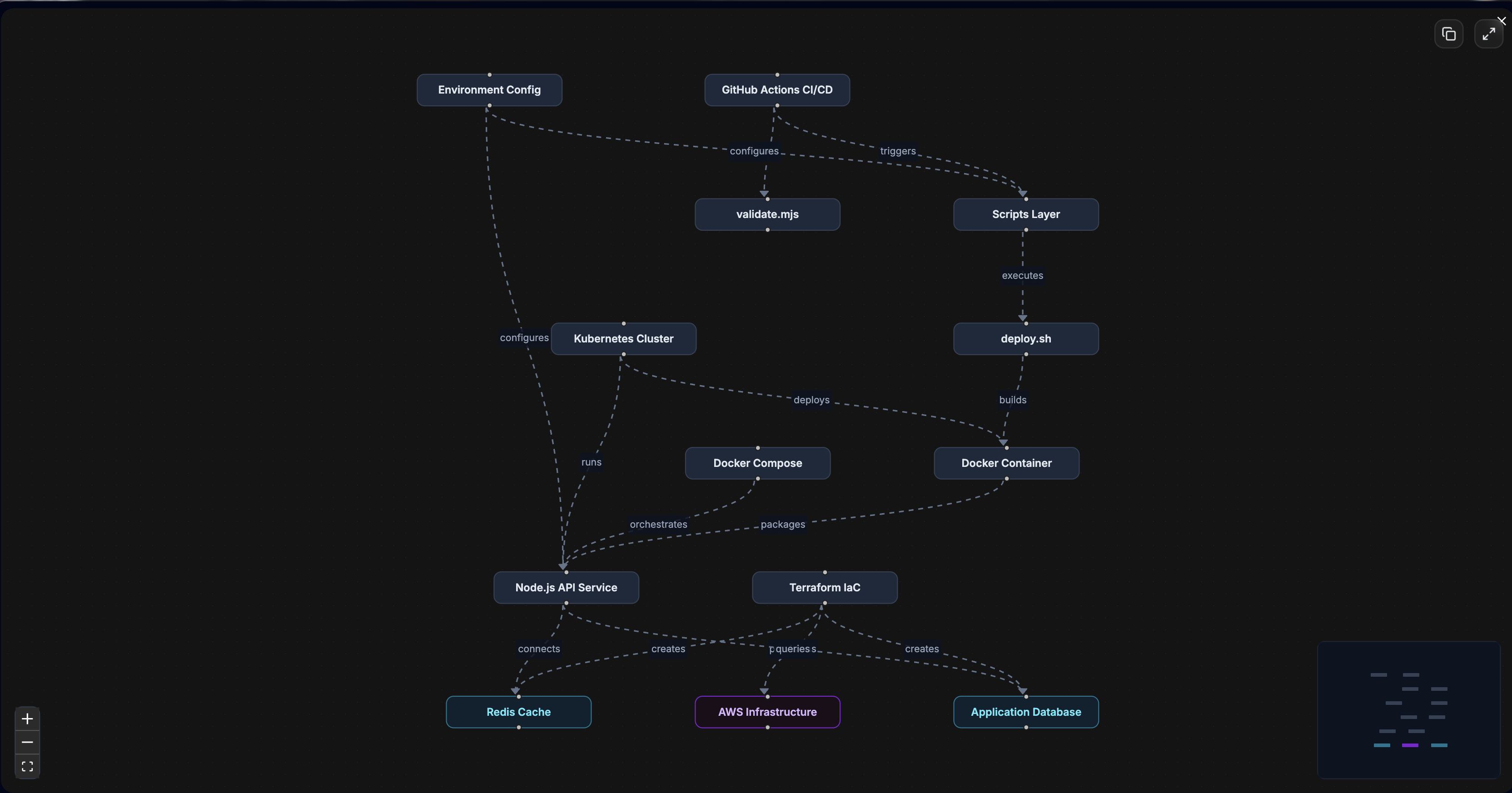
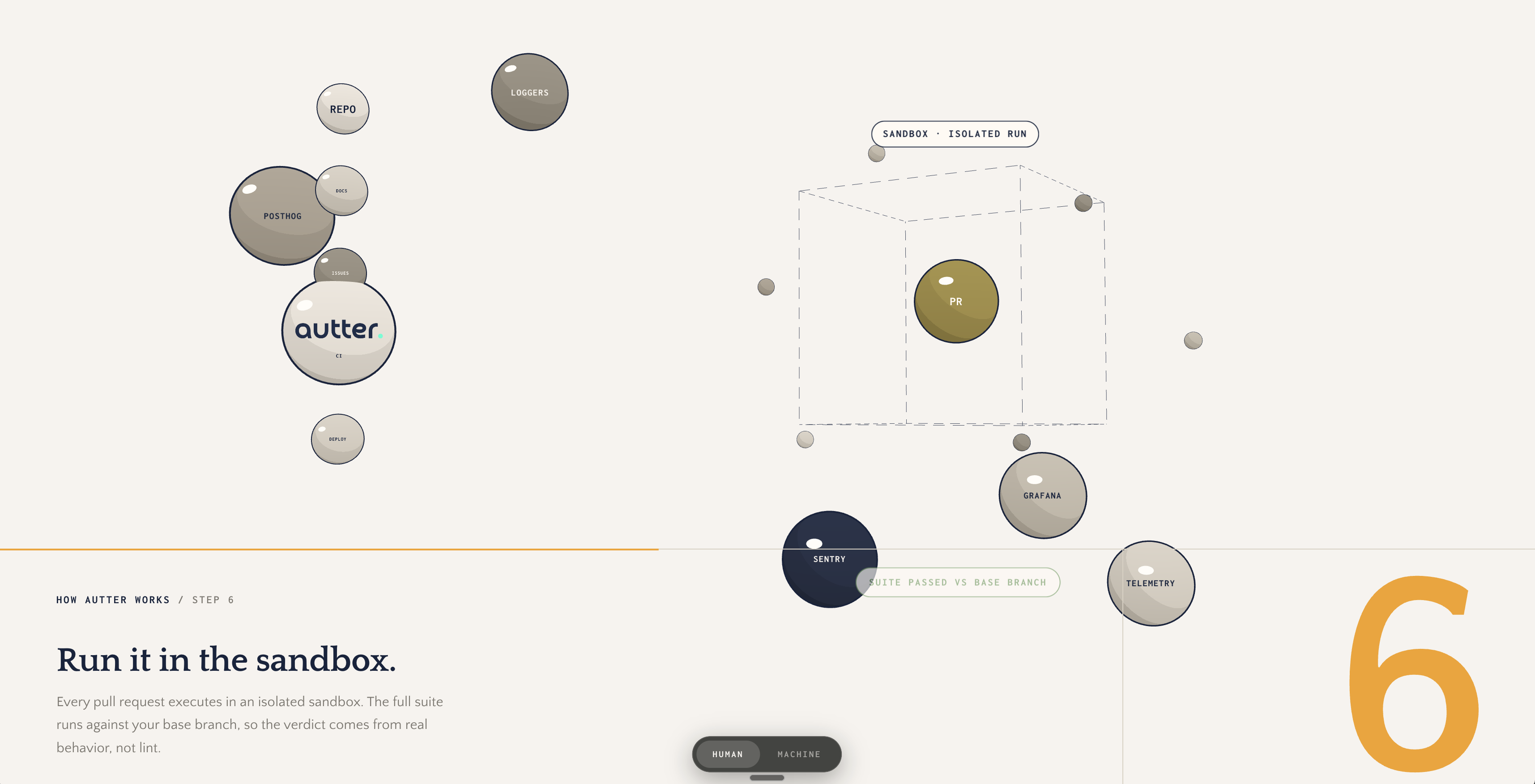
Autter executes every pull request in an isolated sandbox. It resolves dependencies against real registries, runs the suite against the base branch, generates tests around affected journeys, and records the behaviour it observes. The merge verdict is tied to that evidence.
This does not make static review obsolete. It makes static review the beginning of the investigation rather than the end.
A CodeRabbit finding might correctly say that a session change could leave old tokens valid. Autter’s job is to trace the affected flow, exercise it, capture what happened, and keep the merge blocked when the result does not satisfy the repository’s rules.
That is the line between review and assurance. One identifies a plausible problem, while the other has to resolve whether the problem exists.
A check you can override is still a policy choice
CodeRabbit can block merges when its Request Changes workflow and error-mode checks are configured. It can also allow specified reviewers to ignore failed checks and unblock the pull request, which is a reasonable design for a reviewer-led workflow.
Autter takes a harder position. Its product page describes the merge block as non-negotiable until the required checks clear, because the gate is meant to represent the team’s release policy rather than another reviewer’s opinion.
That difference matters when standards have consequences. “Payment writes must be idempotent” is not useful as a wiki sentence if the payment change can merge without idempotency being verified. “Authentication changes need security review” is not a policy if the engineer rushing a release can simply decide that this change is probably fine.
In Autter, teams can attach different requirements to different kinds of changes. Authentication work can require security approval and integration coverage. Migrations can require backward-compatibility and rollback checks. Dependency changes can require registry and reachability verification. Infrastructure work can require the service to boot and behave correctly in an isolated environment.
The value is not that these are clever rules. Most experienced teams already know which rules they want. The value is that the rule becomes part of the path to merge instead of a sentence someone has to remember at 6:30 on a Friday.
AI authorship is useful context, not a scarlet letter
Git tells you who committed the code. That answer becomes less informative when the developer directed an agent that wrote most of the change.
The code may still be excellent. The issue is that the team has lost context about how it was produced, which tool generated it, and how much independent verification should be applied.
The Autter CLI records line-level AI attribution in Git, including the agent, model, and prompt behind generated lines. It can operate locally, and the attribution is stored in Git Notes so it can travel with repository history.
That makes authorship available as a governance signal. A team can inspect whether a risky area was mostly written by a human or an agent, compare the reliability of different agent workflows, and require deeper verification when the source of a change warrants it.
The point is not to make AI-written code guilty until proven innocent. The point is to stop acting as though code provenance tells us nothing.

CodeRabbit’s rate limits are clearer now, but they still matter
CodeRabbit charges per developer. Pro is listed at $24 per developer per month on annual billing, while Pro+ is $48. The corresponding month-to-month prices are $30 and $60.
Those plans include rolling hourly review allowances. Pro starts at five PR reviews per developer per hour, while Pro+ starts at ten. Automatic incremental reviews after a push, manual review requests, and manual full reviews each consume an available review. When none remain, the next review waits unless the organisation has enabled the paid usage-based add-on.
The word “starts” matters. CodeRabbit’s fair-usage policy progressively reduces review availability for developers with high recent activity. Pro drops to one review per hour after 60 reviews in the previous seven days, while Pro+ drops to one review per hour after 90.
The policy is documented, so it would be wrong to call the mechanics secret. It can still be difficult for a team to reason about the effective limit during an agent-heavy week.
A coding agent does not produce work in a neat average. It may open several pull requests during a migration, push multiple corrections to the same branch, or trigger full rereviews while an engineer is iterating. The team then has to consider not only the advertised hourly allowance, but also which actions consume it and how the previous seven days of activity affect current availability.
Recent discussions in the CodeRabbit subreddit include users complaining about longer-than-expected waits and review availability that felt inconsistent with the headline allowance. Those comments are anecdotal and should not be treated as representative of every customer, but they show why buyers care about predictability rather than only the number printed beside “reviews per hour.”
CodeRabbit: Pro falls from 5 to 1 review per hour after 60 reviews. Pro+ falls from 10 to 1 after 90.
Autter: Recent activity does not reduce availability. Each plan includes a fixed number of pull requests a month, and reviews pause at that cap.
Autter prices the thing being reviewed
Autter does not charge by developer seat. It charges by the number of pull requests reviewed each month, so adding engineers or coding agents never changes the bill.
Harbour includes 10 reviews a month for free on one repository. Port costs $20 a month and includes 40 PRs. Cargo costs $40 and includes 100 PRs. Fleet costs $80 and includes 300 PRs. Enterprise is custom pricing for SSO, on-prem deployment, and higher volume.
Every plan is a flat monthly price. Once a plan uses its included reviews, additional PRs wait until the next month. Paid plans keep reviewing and bill the extra pull requests: $1.20 on Port, $0.90 on Cargo, and $0.60 on Fleet. There is no rolling hourly slowdown.
That pricing model matches how agent-heavy teams tend to think. They may have five engineers using several coding agents across twenty repositories. Seat count does not tell you much about the amount of code that needs review, while pull-request volume does.
It also removes a strange operational question from the workflow. An engineer should not have to wonder whether pushing another fix will consume the last review of the hour, whether yesterday’s agent activity has reduced today’s availability, or whether the team should delay a rereview until the allowance refills.
With Autter, the commercial trade-off is visible. The plan includes a known number of pull requests, and the next pull request has a known price.
Can CodeRabbit and Autter run together?
They can, provided the team gives them different jobs. CodeRabbit can remain the everyday reviewer that helps developers understand a change, catch issues early, apply quick fixes, and get feedback in the IDE or CLI.
Autter can sit later in the path as the release gate. It can run the change, verify the affected journeys, apply repository policy, and decide whether the available evidence is enough to unlock the merge.
Using both products to leave similar comments on the same lines would create noise. Using one to improve the change and the other to verify whether it is safe creates a coherent pipeline.
That setup will not be necessary for every team. It makes sense when review quality and release assurance have become separate problems.
When CodeRabbit is enough
CodeRabbit is a reasonable choice when human review capacity is the main constraint. It gives developers fast feedback, broad workflow coverage, configurable checks, and a mature review experience across the pull request, IDE, and CLI.
For many teams, that is the problem they need to solve. Their code volume is manageable, their release policies are lightweight, and an experienced reviewer remains involved in every important decision.
Autter is not arguing that every engineering team needs a heavy gate around every change. A low-risk internal application with a small, senior team may get more value from faster review than from deeper verification.
The argument changes when agents produce a meaningful share of the code, small changes can have a wide blast radius, and the cost of a bad merge is high enough that “a reviewer looked at it” is no longer sufficient evidence.
When the merge needs its own product
At some point, faster review stops solving the actual bottleneck. The team can read the pull request sooner, respond to the findings sooner, and still lack confidence that the change behaves correctly across the application.
That is the point where the merge decision needs its own system.
Autter runs the pull request, traces what it can affect, applies the rules that matter for that kind of change, and keeps the gate closed until the evidence clears. It also records which parts were written by an agent, because the provenance of a change is now part of understanding how much verification it deserves.
CodeRabbit is built to help engineers review more code. Autter is built for the moment when producing more review is no longer the same as producing more trust.
Agents will keep writing more of the code. The uncomfortable question is no longer whether a review tool can comment on all of it, but whether your team has a defensible reason for letting it ship.
That is the job Autter is built to do.