


Apr 8, 2026
We Spent 3 Weeks Fighting About Names
Naming a startup is probably not the most important thing you'll do. But get it wrong and you'll pay for it quietly, in every intro, every cold email, every 'wait, how do you spell that?' on a call.
We were Shipgate first.
Then we weren't.
Then we were something else for about four days. Then that domain was taken. Then we almost settled on something that sounded like a SaaS accounting tool. Then Tanvi said no. Then I said no to her suggestion. Then we both sat quietly for a bit.
Three weeks. That's how long naming Autter actually took.
And here's the honest take before I get into any of it: naming is probably not the most important thing you'll do as a founder. The product is. The people are. Whether anyone actually needs what you're building is. A great name with a bad product is just a fast way to build a recognizable failure.
But.
A bad name will cost you. Quietly. Consistently. In every intro, every cold email, every "wait, how do you spell that?" on a call. So while it's not the hill to die on, it's worth getting somewhat right.
Here's what we learned doing it.
Start With the Category, Not the Brand
The first mistake most founders make is going straight for "what sounds cool." We did this too.

Shipgate was the first serious contender. It had energy. It sounded like it belonged in a developer workflow. Ship, gate, it practically described the product. We were building a merge gate for AI-assisted code. Felt clean.
But we kept hitting a wall.
"Shipgate" was category-adjacent, not category-defining. It told you something happened at the gate. It didn't tell you what the gate did or why you'd want one. For a product in a genuinely new space, that's a problem. You're already asking people to believe in a category that doesn't fully exist yet. Your name can't add more cognitive load on top of that.
“The framing that unlocked everything was the harbour.”
The framing that unlocked everything was the harbour.
Autter is built around the idea of a harbour master. The person who decides what comes in, what goes out, and what's not ready yet. Runtime-aware, security-aware, schema-aware. A judgement layer, not just a check. Once we had that framing locked, we needed a name that lived inside that world without screaming "nautical startup."
Autter. The outer harbour. The boundary before you're inside.
It also came from “Auditing Otter”, which was the dumb internal phrase we kept using while we were building an auditing layer for merges.
The otter part mattered too. Otters are obsessive. They pry things open. They hold onto what they care about and they do not let go. That was the vibe we wanted: a little guard animal that sits on your PRs, checks what changed, and refuses to wave you through.
“Auditing” plus “otter” became Autter. It stuck just enough to become the name.
It fit. Not because it was clever. Because it was accurate.
Domain Availability Will Humble You
We had a shortlist of eight names at one point. Good names. Names we'd actually use.
Six of them were taken. Two of the remaining had .com parked by domain squatters asking for mid-five figures.
This is normal. This is also annoying.
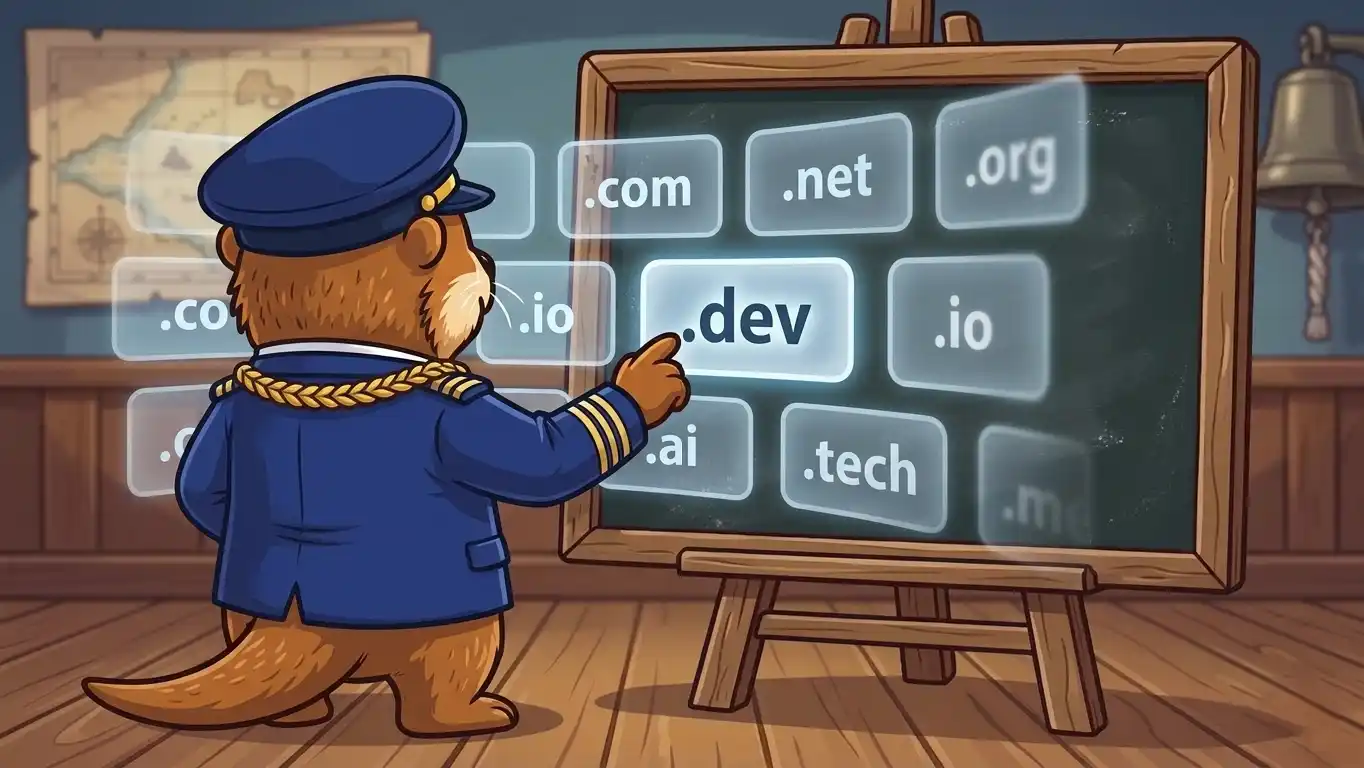
What changed our shortlist entirely was deciding early that we'd go .dev over .com. Not as a compromise. As a deliberate call.
.dev is a gTLD that Google owns. It's HTTPS-only by default. More importantly, it signals something to the audience we care about: developers. When you see a .dev domain, you're not thinking consumer app. You're thinking tool, API, infrastructure, something built for people who build things. That's exactly where we want to live.
Once we committed to .dev, the shortlist opened up. Names that would've been dead ends on .com were clean on .dev. Autter.dev was available. We registered it the same day.
Memorability Is a Function of Friction
We tested names by doing one thing: saying them in a sentence out loud.
"Check out what we're building at ______."
If there was any pause after that blank, any moment where the other person had to process the spelling or the pronunciation, we killed it.
“A name that needs explaining has already failed its first job.”
A name that needs explaining has already failed its first job.
Autter has one point of confusion: the double-T. People occasionally write "Outer." We've made peace with that. The trade-off is worth it because once someone has it, they have it. Two syllables, phonetic, no ambiguity on how to say it. In a pitch, on a call, in a Slack message, it holds up.
We also ran a basic searchability test. Google the name. Google it with "startup." Google it with the product category. If the results are full of noise or completely unrelated things, that's a discoverability problem you'll be fighting for years.
What Almost Made the Cut (And Why It Didn't)
A few names that got real consideration before we landed:
Portgate: Too on-the-nose. Also sounded like a political scandal.
Gatekeeper: Already everywhere. Zero differentiation.
Mergelock: Tanvi hated it. She was right.
Conduit: We liked it. The .dev was taken. End of story.
Harbour: Beautiful word, terrible searchability. Try ranking for that.
Vessel: Almost. But it felt more like a data tool than an enforcement layer. Didn't survive the "what does this do?" test.
Every name that made the shortlist was killed by one of three things: domain issues, category mismatch, or the sentence test. If you're naming right now, those are your three filters.

The debates on the name were actually about something else: They weren’t really about the name. They were about how we saw the product.
I kept pushing for names that explained the product - that’s what developers like, keeping things simple. Names like Shipgate, Mergelock, anything that felt like it could sit inside a developer’s work flow diagram and immediately make sense.
Whereas, Tanvi kept pushing for names that would change a developer’s pov on these tools. A name with a story, a name with an emotion, a name that would kindle curiosity.
There was a phase where every suggestion from one got an immediate no from the other. Not even a discussion. Just instinct. And that was frustrating.
But looking back, that friction was useful.
Because every time a name got rejected, it gave us answers to the layers of building a product:
- Are we just a tool or a companion-tool?
- Are we descriptive or abstract?
- Do we want to sound serious or slightly playful?
We didn’t have aligned answers to those questions in week one.
By week three, we did. We had a story. We had a mascot. The name came after that.
The Real Lesson
Three weeks feels long. It also feels like a lot given how much else was happening during that time, early product work, first investor conversations, figuring out how Tanvi and I were dividing the build.
But naming forced us to get precise about what we were building. Not in a deck. In a word.
What is the single thing this product does? What's the one idea someone should walk away with?
For us, the answer was judgment. A harbour master for your merge queue.
The name came from that. Not the other way around.
“Stop picking names. Go back to the product. Get the one-sentence answer right first.”
So if you're three weeks into a naming spiral and nothing is clicking, stop picking names. Go back to the product. Get the one-sentence answer right first. The name is just a shortcut to that sentence. Once the sentence is clear, the name finds you faster than you'd expect.
We shipped Autter. We like the name. We still think the product matters more.
But we're glad we got the name right enough.
Building Autter in public. If you're an early-stage team shipping code with AI tools and want a merge gate that actually understands what's happening at runtime, we'd love to talk. Drop us a line at hi@autter.dev or book 30 minutes.